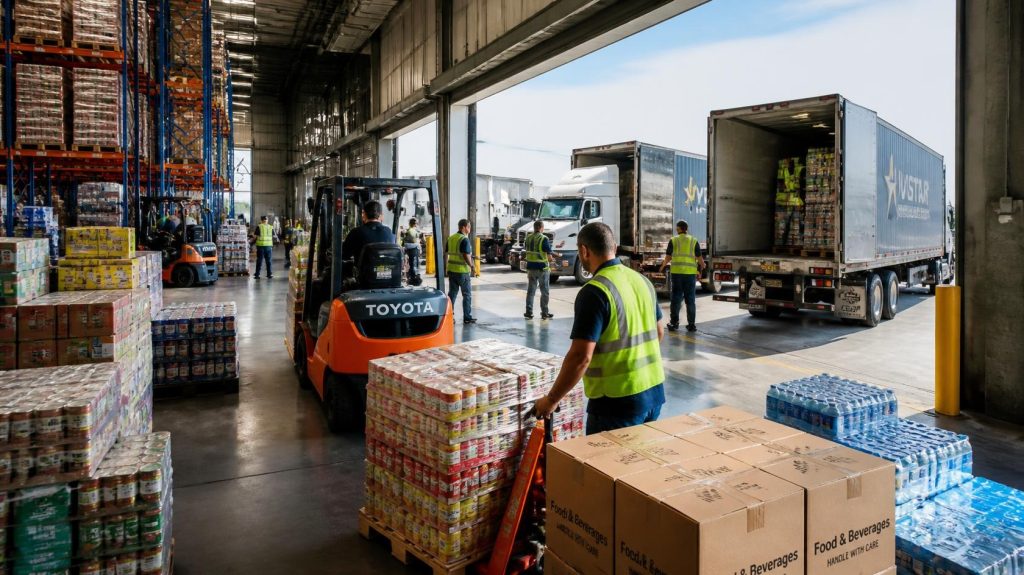
Australian food and beverage distributors are running businesses that would have been unrecognisable a decade ago. Customers expect same-day delivery, temperature-controlled cold chain, allergen and provenance traceability, and consistent digital ordering — all while margins compress under freight, energy and labour cost pressure. The businesses that are pulling ahead aren’t the ones with the deepest catalogues or the biggest fleets. They’re the ones who’ve replaced fragmented systems with a single operational platform, and who use that platform to remove friction from every part of their operation.
For most Australian mid-market food and beverage distributors, that platform is Oracle NetSuite — deployed and supported by AVT with the industry-specific configurations that make it fit food’s genuine complexity. This paper explains how food and beverage distributors use the NetSuite + AVT stack to grow and scale operations: the specific automation levers, the outcome metrics we routinely see, and the operational patterns that separate the food businesses growing 20%+ year-on-year from those that are stuck.
Why food distribution is one of the hardest verticals to scale
Food and beverage sits at a difficult intersection: high-frequency, low-margin, perishable, regulated, and temperature-sensitive. Every one of those characteristics compounds the difficulty of scaling. The five patterns that break generic ERPs (and cost operators sleep):
- Catch-weight billing. A 20kg carton of chicken breast doesn’t weigh exactly 20kg. Every case ships at variable weight and needs to be billed at the actual dispatched weight, not the nominal. Generic ERPs either force you to average (revenue leakage) or add a manual reconciliation step (labour cost). Neither scales.
- Temperature-zone warehousing. Frozen, chilled, ambient, and produce all need to be picked, staged and loaded in the correct sequence and temperature — dry goods on the truck first, chilled next, frozen last. Get it wrong and you cook the frozen while the chilled thaws in the dock.
- Delivery-run economics. The cost to deliver isn’t per order — it’s per stop, per kilometre, per driver-hour, per fuel dollar. Understanding whether a customer is actually profitable requires attributing route cost back to customer margin, not just product margin.
- Perishable inventory management. Traditional stock reorder logic doesn’t work when inventory rots. You need first-expiry-first-out (FEFO) picking, expiry-triggered price discounts, and demand forecasting that accounts for spoilage curves.
- Compliance and traceability. Australian food distributors operate under FSANZ, HACCP, allergen labelling, country-of-origin, and increasingly ESG/sustainability reporting requirements. Batch-level, lot-level, and even carton-level traceability isn’t nice-to-have — it’s regulatory table stakes.
Piecemeal fixes make each problem worse. A separate WMS bolted on to a generic accounting platform can handle temperature zones but adds another system to keep in sync. A separate route-optimisation tool can plan the delivery run but doesn’t know your customer margins. The food distributors who scale successfully are the ones who solve all five on one integrated platform. That’s what NetSuite + AVT delivers.
The AVT food distribution platform — beyond NetSuite core
Oracle NetSuite provides the foundation — multi-location inventory, financials, subsidiary consolidation, order management, native WMS and eCommerce. AVT’s food distribution reference implementation adds the industry-specific layer that makes NetSuite genuinely fit for Australian food operations:
- Catch-weight capture at the dock, flowing straight to invoicing — no manual weight reconciliation
- Temperature-zone WMS workflows — pick tasks sequenced by zone so pickers work cold-to-warm and load order matches unloading order
- Delivery-run management — orders grouped by route, released to the warehouse by run, cost-attributed by stop
- Batch, lot and expiry-date tracking — FEFO picking, expiry alerts, batch-level customer traceability for recall response
- Allergen and provenance data model — customer allergen alerts on order entry, country-of-origin flowing through to invoices and dispatch dockets
- Customer pantry visibility — sales reps see the customer’s typical ordering pattern, current on-order, and last delivery on one screen
- Live supplier cost tracking — every supplier price change flows to margin analysis immediately, not at month-end reconciliation
This is the layer that separates a NetSuite deployment that “works for food” from a NetSuite deployment that “makes the food business scale.” AVT’s 100-day implementation methodology delivers this reference implementation as a fixed-scope, fixed-timeline project — not as a discovery-driven consulting engagement that runs for 9 months.
The seven scaling levers that grow food and beverage operations
1. Sales-team leverage — reps quote and take orders faster
The biggest single sales bottleneck in food distribution is order-entry speed. Reps who can only take 30 orders per day cap the entire operation. With NetSuite + AVT customer pantry visibility, reps see every customer’s typical order pattern, last delivery, credit position and allergen requirements on one screen — order entry drops from minutes to seconds. Combined with our SuiteOrder mobile app for customer self-service, most F&B distributors we work with double or triple their order-capture capacity without adding sales headcount.
2. Warehouse leverage — pick more with the same team
Barcoded temperature-zone pick-pack-ship, wave picking optimised to route sequence, and real-time cycle counting turn the warehouse into a scaling engine. Pickers walk less, handle less, and touch each item fewer times. Australian food distributors routinely see 40-70% reductions in pick errors and 30-50% throughput improvements after proper WMS deployment on NetSuite.
3. Delivery-run economics — profitable growth, not just growth
Growing revenue without understanding delivery-run economics is how food distributors end up bigger but less profitable. NetSuite + AVT’s delivery-run management gives you cost-to-serve at the route level — so when the sales team wants to onboard a new customer 40 minutes past your normal delivery zone, you have the data to price accordingly (or to say no). This alone is often worth 2-3 GP points across the customer base.
4. Purchase automation — supplier cost movements flow to margin instantly
Raw material and packaging costs move constantly in food. Distributors on legacy systems find out about supplier price changes at month-end reconciliation — by which time they’ve been selling at the old assumed cost for weeks. NetSuite + AVT’s live supplier cost tracking pushes cost changes through to your margin analysis in real time, so pricing decisions and quote responses reflect current reality, not last quarter’s assumption.
5. Working-capital release — inventory reduction without service impact
Distributors typically carry 20-40% more inventory than optimal because they don’t have confidence in their demand signals. Proper demand planning on NetSuite (via AVT’s S&OP SuiteApp) — using historical patterns, promotional calendars, seasonality and expiry curves — routinely reduces inventory by 15-30% while maintaining or improving fill rate. For a $50M revenue distributor, that’s $1-3M of released working capital.
6. Customer self-service — reduce cost-to-serve while lifting frequency
Every customer service call answering “where’s my order,” “what’s the price of X today,” “please add another pallet to next delivery” is friction that costs both parties. SuiteCommerce customer portals and SuiteOrder mobile app turn these into self-service moments. Distributors see 40-60% reduction in customer-service call volume plus 10-25% lift in ordering frequency — because low-friction ordering means customers reorder more often.
7. Compliance and audit automation — regulatory scaling without regulatory pain
As food businesses grow, regulatory obligations grow with them. Batch and lot tracking that started as “nice for recalls” becomes “audit-critical for third-party accreditation.” NetSuite’s native lot/serial tracking with AVT’s food configurations means compliance scales with the business without adding compliance headcount. Recall response drops from days to hours. Third-party audit prep drops from weeks to days.
Real-world outcomes from AVT food distribution deployments
Numbers we see routinely across AVT’s Australian food and beverage client base after full NetSuite + AVT deployment:
| Metric | Typical improvement | Business impact |
|---|---|---|
| Order processing time | 60-80% reduction | Same sales team handles 3-5× the order volume |
| Order accuracy at pick face | >99.5% | Fewer credits, fewer complaints, higher NPS |
| Inventory levels (working capital) | 15-30% reduction | $1-3M freed for a mid-market distributor |
| Stock-outs | 50-70% reduction | Higher fill rate, higher revenue retention |
| Days Sales Outstanding (DSO) | 5-12 day reduction | $1M+ working capital improvement for a $50M distributor |
| Month-end close | From 10-15 days → 3-5 days | Finance focuses on analysis, not data compilation |
| Customer service call volume | 40-60% reduction | Handled by portals + automated notifications |
| Gross margin visibility latency | From month-end → real-time | Pricing and stocking decisions made on current data |
| Recall response time | From days → hours | Regulatory confidence, audit-ready |
None of these require heroic effort. They come from the compounding effect of a properly deployed food-specific ERP with the right automation layer sitting on top.
Common scaling patterns we see
Pattern 1: The regional distributor going national
Started single-warehouse, now expanding to a second (or third) location. The critical inflection: multi-location inventory with real-time available-to-promise across sites, plus proper transfer-order workflows and inter-site cost tracking. NetSuite OneWorld handles this natively — the AVT deployment configures it correctly for food’s specific patterns (temperature zones per site, catch-weight per shipment, delivery routes per depot).
Pattern 2: The producer expanding into distribution
Started as a producer selling wholesale, now adding direct-to-retail or direct-to-consumer via eCommerce. The critical inflection: unified customer records across channels, unified inventory pool with channel-specific visibility, and B2B pricing that doesn’t leak to B2C. SuiteCommerce Advanced solves the eCommerce side; AVT’s food-industry configurations make sure the operations underneath don’t break.
Pattern 3: The distributor adding light processing
Started as a straight distributor, now doing repacking, blending, portion-cutting, or private-label manufacturing. The critical inflection: proper BOM/routing tracking for the manufactured items, plus catch-weight capture on input materials AND finished goods. NetSuite’s manufacturing module combined with AVT’s food configuration handles this cleanly.
Pattern 4: The distributor being acquired (or acquiring)
M&A activity in Australian food distribution has been steady. NetSuite is the reference ERP for private-equity-backed food businesses because it consolidates subsidiaries natively, produces audit-ready financials, and standardises operational KPIs across the portfolio. Being on NetSuite significantly increases enterprise value at exit — and dramatically reduces integration cost when acquiring other distributors.
How AVT delivers this for food and beverage operators
AVT Solutions has been implementing and supporting Oracle NetSuite for Australian and APAC mid-market businesses for 20+ years, with deep vertical expertise in food and beverage distribution. Practically for a food client that means:
- Food-specific reference implementation, not a blank canvas. Preconfigured item categories, temperature-zone WMS workflows, catch-weight capture, delivery-run structures, allergen data model, HACCP-friendly batch tracking — all from 100+ prior deployments including food-specific implementations.
- Proprietary SuiteApps for food distribution’s specific gaps. S&OP for demand planning with expiry curves, Collections for AR automation, SuiteOrder for customer mobile ordering, SmartFreight for carrier integration, Print Node for on-demand dispatch documents, Present & Pay for customer AR self-service.
- 100-day implementation methodology. Contract signed to production go-live in a single quarter for standard deployments. Longer for multi-site, multi-entity or heavily customised — but always fixed-scope, fixed-timeline.
- Managed support after go-live. AVT’s managed NetSuite support takes over from day one after go-live, so system admin, integration monitoring, user support and optimisation happen without you hiring internal NetSuite specialists.
- Business systems advisory. Operating model, KPI framework and change planning — the parts of a deployment that determine whether the technology actually changes the business.
The food and beverage distributors we see scaling fastest aren’t the ones with the biggest tech investment. They’re the ones who consolidated around a single food-fit ERP, automated the repetitive operational workflows, and freed their team to focus on customer relationships and channel expansion. NetSuite + AVT makes that possible in months, not years.
Next steps for food and beverage operators
Whether you’re on a legacy ERP that’s holding the business back, on NetSuite already but haven’t captured the food-specific automation upside, or evaluating options for the first time — a structured next step is worth 30 minutes:
- Review the NetSuite for Food & Beverage solution overview to see the reference architecture in detail.
- Build a boardroom-ready NetSuite business case in 30 minutes with AVT’s interactive wizard — includes food-distribution-specific ROI, TCO and payback modelling.
- Book a no-obligation NetSuite evaluation call with AVT’s food distribution specialists to scope your specific operational levers.
- Read the related paper on Scaling Wholesale Distribution with NetSuite & AVT Automation — many of the seven automation levers apply directly to food distribution.