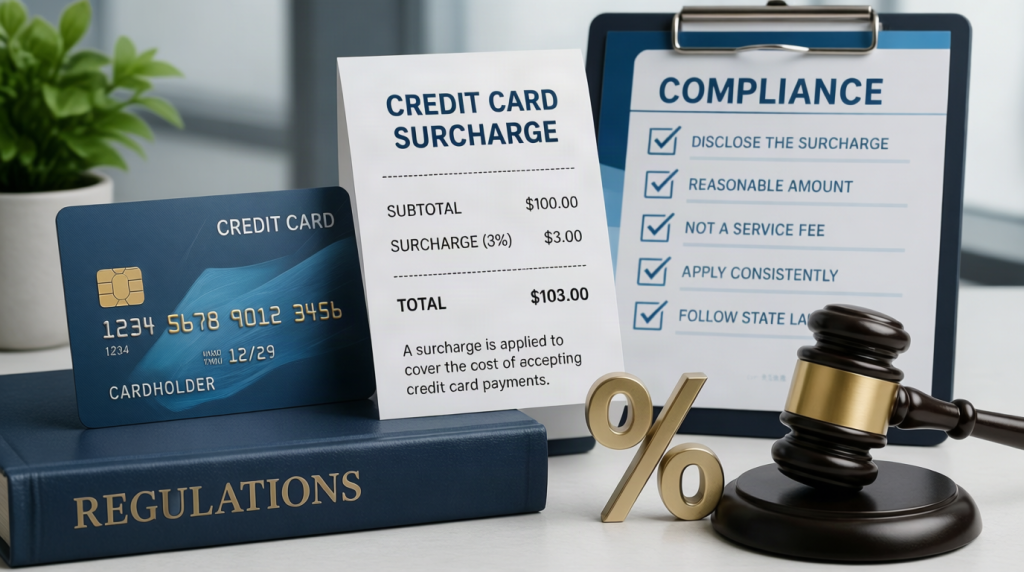
From 1 October 2026, Australian merchants will no longer be able to add credit card surcharges to Visa, Mastercard or eftpos transactions. It’s a change most retailers and B2C operators are already aware of. But for B2B distributors, wholesalers, manufacturers and service businesses — where transaction values are $5,000 to $500,000 and card fees can consume real net margin — the ban’s implications run deeper, and the response requires more than “just absorb the cost.”
This paper explains what’s actually changing, why B2B businesses are structurally more exposed than B2C, the seven legal mechanisms Australian B2B businesses can use to recover payment-processing cost once the ban takes effect, and a practical three-phase playbook for the next 12 months. It’s written for CFOs, COOs and finance leaders at Australian mid-market businesses running Oracle NetSuite or evaluating operational-cost recovery strategies ahead of the ban.
What the 2026 ban actually is (and isn’t)
The Reserve Bank of Australia has finalised a change to Australia’s card payments framework: from 1 October 2026, Visa, Mastercard and eftpos will prohibit merchants from adding surcharges to card transactions. Enforcement runs through your merchant agreement with your acquiring bank — if you take card payments today, your acquirer contract will be updated with the no-surcharge clause. Non-compliance risks the loss of card acceptance.
Key facts worth pinning down:
- Effective date: 1 October 2026. Some acquirers may enforce earlier.
- Cards covered: Visa, Mastercard, eftpos (debit, credit, prepaid).
- Cards NOT covered: American Express and PayPal remain exempt — surcharging is still permitted (capped at actual cost).
- Scope: Applies to all transactions — B2C and B2B, in-person and online.
- Renaming as “admin fee” or “processing fee” is banned. The ACCC has been explicit that substance-over-form applies; renaming a surcharge is misleading conduct under Australian Consumer Law with penalties up to $50M per contravention for corporations.
- The RBA’s rationale: Simplify pricing, reduce consumer confusion, and lower interchange fees so merchants have less cost to recover in the first place.
Why B2B is structurally more exposed than B2C
B2C surcharge economics were always small — a coffee shop absorbing 30 cents on a $5 transaction is a rounding error. B2B surcharge economics are a different order of magnitude:
| Factor | B2C | B2B |
|---|---|---|
| Typical transaction size | $50-$500 | $5,000-$500,000+ |
| Typical card fee % | 1.0-1.8% | 1.5-3.5% (higher for corporate/AmEx cards) |
| Dollar impact of one surcharge | Cents to dollars | Hundreds to thousands |
| Payment mix | Cards dominant | Bank transfer/EFT dominant, cards used for convenience |
| Margin exposure | Baked into retail markup | Often 30-70% of net margin on the transaction |
Take a $50M-revenue distributor where 10% of collections ($5M/year) currently flow via card. At an average card fee of 1.8%, they pass on $90,000/year as surcharges — meaning they’re currently neutral. When the ban hits, that $90,000 becomes an absorbed cost — pure margin loss. On a business running 4-6% net margins, that’s $150,000-$375,000 net-margin reduction from what looks like a small change.
Now factor in the second-order effect: B2B customers will use cards MORE once the surcharge disappears. Cards settle instantly, earn reward points, and give the buyer 30-45 days of interest-free credit float. Once there’s no penalty, cards become the rational payment choice for many buyers. Expect card mix to increase 30-70% within 12-18 months of the ban taking effect. That $90,000 cost quickly becomes $150,000-$225,000.
For a $200M distributor, scale the numbers linearly: $360,000 to $1.5M of annual net-margin impact. Material enough to make a properly planned cost-recovery response essential rather than optional.
The seven legal cost-recovery mechanisms B2B businesses still have
1. Base-price adjustment (universal price increase)
Instead of charging $10,000 + 1.8% surcharge, charge $10,180 flat regardless of payment method. Everyone pays the same base price.
Status: Fully permitted — it’s just pricing.
Tradeoff: Bank-transfer customers effectively subsidise card users. But you recover the aggregate cost of your payment mix.
Best for: Businesses without practical customer-level differentiation (spot sales, catalogue pricing).
2. Payment-method-specific pricing on the price list
Your commercial price list explicitly quotes different prices for different payment terms: “$10,000 — 30-day EFT” or “$10,180 — credit card”. Customer chooses at order stage.
Status: Legal — this is a two-tier price offering, not a surcharge. Both prices are disclosed before order.
Tradeoff: Requires clear communication in quotes and orders. Systems must handle multiple price levels. Customers may push back on transparency.
Best for: Contract pricing, quote-to-cash workflows where quotes precede orders. Common in wholesale and manufacturing.
3. Early-payment discount (the inverse of a surcharge)
Standard net-30 price is $10,000. Pay in 7 days via EFT and receive 2% off — $9,800. Customer paying by card on delivery pays the full $10,000.
Status: Completely legal, and actively encouraged. A discount for early payment is not a fee for card usage.
Why it works economically: Recovers the card cost via foregone discount rather than added fee. Customer paying by card = you receive $10,000 and lose $180 to interchange. Customer paying by EFT early = you receive $9,800 with negligible processing cost. Net-to-you is virtually identical — but the customer perceives it as receiving a discount rather than being penalised.
Bonus: Directly improves DSO. A 2% early-payment discount that shifts 30% of collections into 7-day settlement can pull DSO down 3-5 days.
Best for: Every B2B business with terms. This is arguably the single most elegant workaround.
4. Contract-based cost pass-through (bilateral B2B contracts only)
Your master supply agreement with an enterprise customer includes a clause: “Customer agrees to reimburse Supplier for actual card processing costs incurred in the event of card payment.” Invoice explicitly itemises the pass-through.
Status: Grey area, legally untested. Some legal opinions hold that a bilaterally negotiated B2B contract clause is a contractual pass-through rather than a merchant-imposed surcharge. But the position hasn’t been tested, and the ACCC may challenge it if used widely.
Best for: Only with legal advice. Only in genuine bilateral commercial contracts (not standard-form order confirmations). Only for the small number of enterprise customers where the dollars justify the legal risk.
Recommendation: Don’t rely on this as a systemic solution. Treat as a fallback for a handful of contracts, not a business-wide policy.
5. Payment-method steering (make preferred methods easier)
Offer PayTo, PayID, direct debit and bank transfer as the promoted payment methods on your invoices and portals. Card is available but requires an extra click, an extra portal, or is offered as the fallback.
Status: Fully legal. Not surcharging cards — just making other methods more convenient.
Why it works: Modern payment rails settle in seconds (PayTo is essentially instant) at $0.05-$0.20 per transaction versus $50-$500 for large card transactions. Once B2B customers experience PayTo — pay directly from their business bank app, instant reconciliation, no re-entering card details — most prefer it.
Best for: Every B2B business. Best done by investing in AR self-service infrastructure now, so it’s ready by October 2026.
6. Transaction-size limits on card acceptance
“Card payments accepted up to $50,000. Orders above $50,000 require EFT or bank transfer.”
Status: Legal — it’s a business policy, not a surcharge.
Why it works: Directly addresses the pain point (large-transaction card fees) without inconveniencing normal small-order card users. On a $75,000 order, a card fee at 1.8% is $1,350 — often more than the profit margin on the sale. Setting a maximum removes this cost concentration.
Best for: Distributors with a small number of very large orders that generate outsized card fees.
7. Third-party B2B finance for card-paying customers
Partner with a B2B finance provider (Trade Ledger, Marketplace Finance, various bank offerings). When a customer wants to pay by card, route them to the finance partner who charges the customer, pays you in full immediately.
Status: Legal. The finance provider is a separate party dealing with the customer.
Why it works: You receive full payment upfront. Customer pays their finance provider on their own terms (with the finance provider carrying the card cost). Effectively shifts the cost off your business.
Best for: Larger transaction values ($10K+), sophisticated customers who want extended terms anyway. Common in equipment sales, capital goods, wholesale-to-retail.
What you cannot do — the practices to avoid
| Practice | Status | Risk |
|---|---|---|
| Adding “credit card surcharge” line to invoice | Banned | Merchant agreement termination + ACCC action |
| Renaming as “admin fee”, “processing fee”, “service fee”, or “convenience fee” | Banned | ACCC treats as misleading conduct — up to $50M per breach for corporations |
| “Payment handling charge” for card payments | Banned | Same substance-over-form principle |
| Displaying “card price / EFT price” only after order confirmation | Banned | Both prices must be disclosed before transaction |
| Refusing to accept certain cards from your card scheme | Depends on acquirer contract | Most Visa/Mastercard merchant agreements require acceptance of all card tiers |
The recommended three-phase B2B playbook
Phase 1 — Prepare (now until October 2026)
- Audit current card mix. What percentage of your collections comes via card? What’s your average card fee percentage? What’s the annual dollar cost to your business? These numbers frame everything that follows.
- Build the AR self-service infrastructure. Customer payment portal, PayTo and PayID rails, direct debit setup, automated invoicing on dispatch. This is the platform that lets you steer payment method in Phase 2.
- Introduce a 2% early-payment discount for EFT within 7 days on standard terms. Start training customer behaviour now, before the ban takes effect.
- Review commercial contracts with your top 20 customers. Where dollar volumes justify it, consider adding cost-recovery language in the next contract renewal (with legal advice).
Phase 2 — Ban takes effect (October 2026)
- Continue accepting all cards. Required under your merchant agreement. No drama, no customer conversation about surcharges disappearing.
- Promote non-card methods as the default in every payment touch-point (invoice, portal, statement, order confirmation, sales rep script).
- Apply a modest base-price adjustment (~0.5-1%) to absorb residual card cost.
- Consider a maximum card transaction size ($20K-$50K depending on your business) for orders above that threshold.
- Communicate positively to customers. “No more surcharges, plus new 2% early-payment discount” is the framing — pure positive spin.
Phase 3 — Optimise (12 months after ban)
- Measure card mix shift. If your investment in AR steering worked, you’ll see significant migration to PayTo/EFT — a win. If card mix increased, you need to raise base price further to compensate.
- Enterprise customer contracts. Negotiate contractual cost-recovery clauses in master supply agreements where the customer relationship supports it.
- Refine early-payment discount rate based on actual DSO improvement observed. Discount rate that maximises P&L is usually 1.5-2.5% for 7-day settlement.
The AVT + NetSuite angle
Everything above assumes the business has proper AR automation infrastructure. On NetSuite, that means:
- NetSuite native AR + Payment Application for standard invoicing and receipt matching
- AVT Present & Pay SuiteApp — customer self-service payment portal with payment-method steering. Customer sees choice; merchant steers cost.
- AVT Collections Module — automated dunning that promotes EFT before offering card, with escalation logic for genuine delinquency
- Airwallex integration — PayTo and PayID as native payment rails, multi-currency support for international customers
- SuiteCommerce portal — customer-driven ordering with payment method selection built into the checkout flow
Businesses on NetSuite with these components in place before October 2026 will steer 30-70% of card volume onto cheaper rails in the first 12 months of the ban. Businesses without the infrastructure will absorb full card cost with no operational lever to pull.
The businesses that get ahead of this will spend the next 12 months quietly building the AR self-service infrastructure to steer payments onto lower-cost rails, introducing early-payment discounts to shift customer behaviour, and adjusting pricing modestly to smooth the residual absorption. The businesses that don’t will find themselves eating an unexpected 0.5-2% margin hit in Q4 2026 with nothing built to offset it.
What to communicate — internally and externally
Internal message to finance and AR teams:
The 2026 credit card surcharge ban means we can’t add card surcharges from 1 October 2026. To offset, we’re introducing a 2% early-payment discount for EFT settlement within 7 days, building a proper customer payment portal with PayTo and PayID as the default option, and adjusting base prices by approximately 0.75% across the catalogue. Card remains accepted but becomes the fallback method.
External message to customers:
From 1 October 2026, we’ve simplified our pricing — no more credit card surcharges. To reward customers who pay quickly by EFT, we’re introducing a 2% early-payment discount when you settle within 7 days. Cards remain accepted for your convenience.
The customer hears “no more surcharges, plus new discount” — pure positive framing. You’ve quietly restructured cost recovery around behaviour rather than punishment.
Next steps for Australian B2B operators
Whether you’re on NetSuite already, evaluating NetSuite as your operational platform, or trying to work out what to change before October 2026 arrives — a structured next step is worth 30 minutes:
- Review the AVT Present & Pay SuiteApp — the customer AR self-service infrastructure that makes payment-method steering practical at scale.
- Build a boardroom-ready NetSuite business case in 30 minutes with AVT’s interactive wizard — includes ROI on AR automation and cost-recovery scenarios.
- Book a no-obligation NetSuite evaluation call with AVT to scope your specific card mix, cost exposure, and the AR automation build that fits your business.
- Read the Scaling Australian Food & Beverage Distribution with NetSuite paper for the broader operational-leverage playbook that pairs with this cost-recovery strategy.
This paper is prepared as reference for AVT clients considering their B2B cost-recovery strategy ahead of the 1 October 2026 credit card surcharge ban. It does not constitute legal or financial advice. Businesses should consult their own legal and financial advisors on the application of the ban and cost-recovery mechanisms to their specific circumstances.