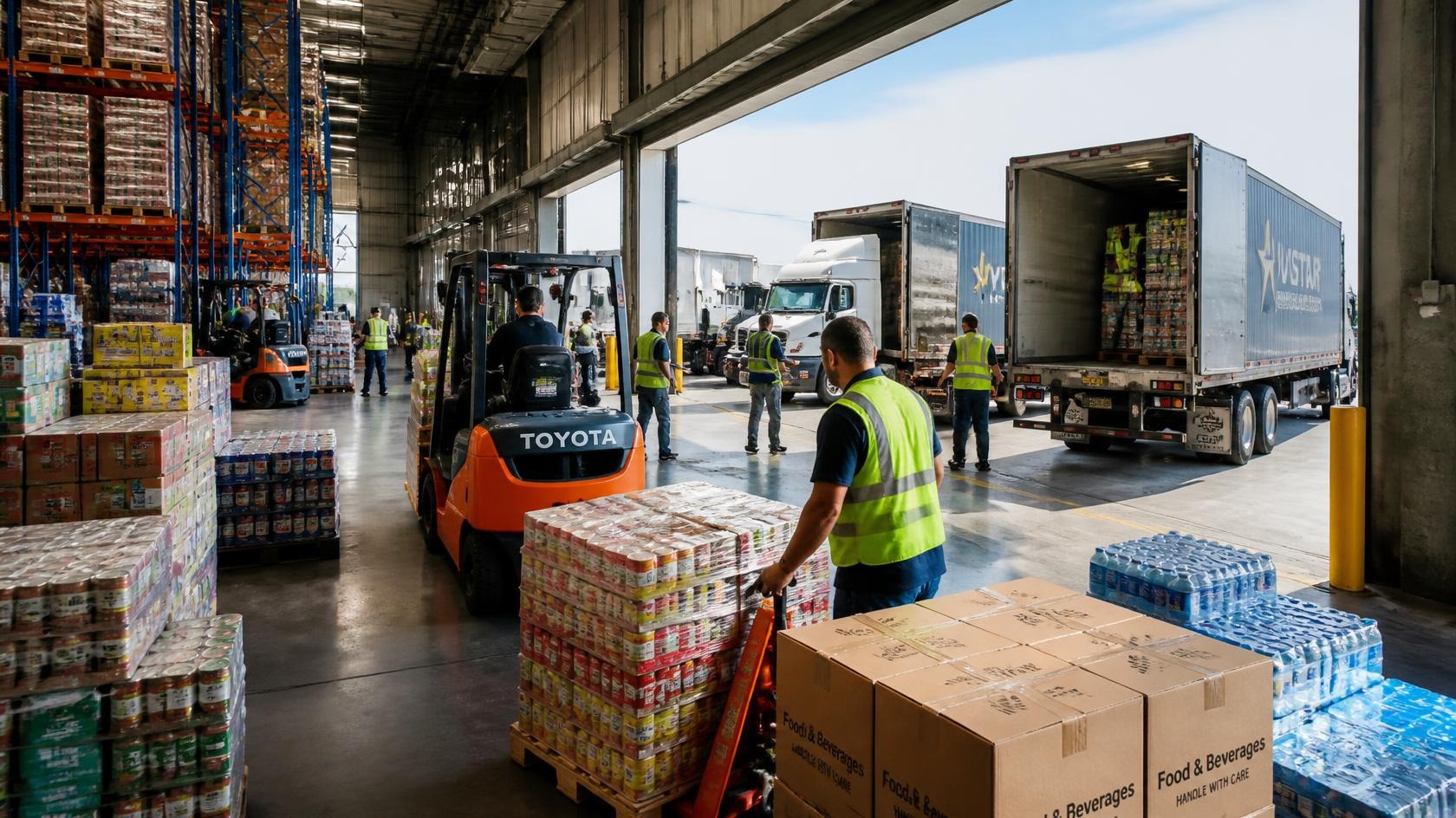
Australian wholesale distribution is not the same business it was five years ago. Customer buying patterns have shifted. B2B buyers now expect the same real-time visibility, mobile ordering and self-service they get from consumer platforms. Freight and logistics costs keep climbing. Margins are thinner. Supply chains are longer and more volatile. And the biggest single differentiator between distributors who are growing and those who are stalling is no longer catalogue depth or reach — it’s operational leverage: the ability to handle more volume, more customers, more SKUs, more channels, without a proportional increase in headcount.
That’s what NetSuite delivers when it’s implemented properly — and what AVT Solutions has spent 19 years helping Australian mid-market wholesalers achieve. This paper explains how distribution businesses use the combination of Oracle NetSuite and AVT’s automation playbook to scale operations, reduce manual work, and turn logistics from a cost centre into a competitive advantage.
Why wholesale distribution is uniquely hard to scale
Wholesale distribution sits at a difficult intersection: high-volume, low-margin, logistically complex, and customer-facing. The five compounding challenges we see most often at Australian mid-market distributors:
- Fragmented systems. Accounting in one platform, inventory in another, a WMS bolted on, an eCommerce storefront running separately, EDI feeds from major customers in their own bucket, sales rep orders in email and spreadsheets. Every handoff between these systems is a place where data breaks, orders get lost, and manual re-entry burns hours.
- Inventory visibility gaps. Stock in the warehouse, stock in transit, stock reserved for open sales orders, stock committed to backorders, stock at a 3PL, stock in a customer consignment location — most distributors can’t answer “what do I actually have available to promise right now?” in real time. This shows up as overselling, missed dispatch windows, and forced expediting.
- Multi-channel demand. Direct sales reps, telephone orders, EDI from national accounts, an eCommerce site for smaller trade customers, a marketplace presence — each channel has its own workflow, pricing rules, and customer expectations. Distributors trying to manage this in a single ERP without proper automation end up either dropping channels or drowning in exception handling.
- Customer credit and collections drag. Distribution is a working-capital business. Every day of DSO ties up cash. Manual invoice generation, chasing PO numbers, dispute resolution, and collections calls consume disproportionate finance-team time — and the automation opportunity here is enormous.
- Reporting lags reality. By the time month-end financials tell you which SKUs, which customers, which channels, and which routes are actually making money, the quarter is over. Distributors without real-time margin analysis are making pricing and stocking decisions on stale data.
Every one of these is fixable. But fixing them piecemeal — bolting one system onto another — usually makes things worse. The distributors who scale successfully are the ones who consolidate around a single operational platform and then systematically automate the workflows on top of it.
Why NetSuite is the reference architecture for mid-market distribution
Oracle NetSuite is the most widely deployed cloud ERP in mid-market distribution globally, and there are structural reasons for that. Native multi-location inventory, real-time available-to-promise, subsidiary-level financial consolidation, price-level and contract-price management, landed-cost tracking, catch-weight and lot/serial tracking, EDI integration, WMS capability, and a proper eCommerce layer (SuiteCommerce) — all natively part of the platform, without middleware.
For a distributor doing $10M-$200M in annual revenue with 500-50,000 SKUs across one to five subsidiaries in Australia and New Zealand, NetSuite is the sweet spot: enterprise-grade capability with mid-market deployment timelines and pricing. AVT’s 100-day implementation methodology is specifically designed to get distributors from contract signing to go-live within a single quarter for standard deployments.
But the ERP alone is table stakes. The real leverage — and where AVT’s vertical expertise matters — is in the automation layer that sits on top.
The seven automation levers that scale distribution operations
1. Order-to-cash automation
The single most valuable automation for most distributors. Orders coming in from any channel — sales rep, phone, email, EDI, eCommerce, mobile — land as sales orders in NetSuite instantly, with the correct customer, pricing, terms, and delivery schedule already applied. No manual re-entry, no keying errors, no missed cut-offs. AVT’s SuiteOrder mobile app extends this to your trade customers’ phones so repeat orders take 30 seconds instead of 30 minutes of phone tag. Where CPQ is required for configured products, AVT’s CPQ SuiteApp handles rules-based configuration natively inside NetSuite.
2. Warehouse and inventory automation
Barcoded pick-pack-ship workflows using handheld scanners, wave and batch picking to optimise pick paths, bin-level inventory accuracy, real-time cycle counting, and automated stock replenishment triggered by demand signals rather than fixed reorder points. NetSuite’s Advanced Inventory Management module — properly configured — eliminates the “we thought we had it” problem that drives most customer complaints in distribution.
3. Demand planning and replenishment
Distributors who stock what actually sells hold less inventory and stock out less often — both direct margin uplift. AVT’s Sales & Operations Planning SuiteApp automates forecast generation from historical demand, promotional calendars, and lead-time reality, then triggers purchase orders when replenishment is needed. Distributors typically see 15-30% inventory reductions with no drop in fill rate after implementing a proper S&OP process.
4. Collections and cash-flow automation
Automated invoice delivery the moment goods dispatch. Dunning schedules that escalate through email, SMS, and phone without finance-team intervention. AVT’s Collections Module gives collection teams a workbench that prioritises accounts by risk and value, tracks promises-to-pay, and integrates with disputes so the resolution loop closes automatically. For a $50M-revenue distributor, cutting DSO by five days is $685K in freed working capital — a hard number that pays for the entire NetSuite deployment.
5. Customer self-service
Every phone call your customer service team takes to answer “where’s my order”, “when will it ship”, “can I get a copy of that invoice”, or “please add another pallet of X to my next delivery” is friction that costs both parties money. SuiteCommerce customer portals, SuiteOrder mobile ordering, and automated email/SMS notifications from NetSuite events turn most of these interactions into self-serve moments the customer prefers anyway. The direct saving is on customer-service hours; the indirect saving is on customer satisfaction and reorder frequency.
6. Freight and logistics integration
Automated carrier rate shopping at pack time, dispatch documents (labels, manifests, delivery dockets) generated straight from NetSuite, tracking numbers written back to the sales order and pushed to the customer automatically. AVT’s SmartFreight and Print Node SuiteApps handle the physical output — labels, dockets, packing slips — from NetSuite events without ever leaving the ERP.
7. Real-time analytics and margin visibility
NetSuite’s SuiteAnalytics gives operations leaders live dashboards on gross margin by SKU, by customer, by channel, and by route — updated continuously, not monthly. Combined with landed-cost tracking, this lets pricing and stocking decisions be made on current reality, not last month’s guess. For distributors, real-time margin visibility typically surfaces 5-10% of the SKU catalogue that’s actively losing money after freight and returns — and would never have been flagged in a summary P&L.
Where the operational leverage compounds
The individual automations above each pay back on their own. What makes NetSuite genuinely transformational is that they compound when they run together on one platform. A single sales order automatically:
- Applies the correct customer-specific pricing and terms
- Checks live available-to-promise inventory across all locations
- Reserves stock and generates a pick task in the warehouse
- Selects the optimal carrier and generates the shipping documents
- Posts the invoice the moment goods dispatch
- Triggers the dunning schedule if payment isn’t received by terms
- Updates margin analytics with actual landed cost and freight
- Signals demand-planning that replenishment may be needed
Each of these steps used to be a manual handoff between systems and people. With NetSuite and AVT’s automation layer, the entire chain runs without a human touching it — unless something exceptional needs judgement. That’s the operational leverage: your team’s time goes to exceptions, growth work, and customer relationships, not data-entry and system babysitting.
Real-world outcomes from AVT distribution deployments
Numbers we see routinely across AVT’s distribution client base after full NetSuite + automation deployment:
| Metric | Typical improvement | Business impact |
|---|---|---|
| Order processing time | 60-80% reduction | Same team handles 3-5× the order volume |
| Order accuracy | >99.5% at the pick face | Fewer returns, fewer credits, higher customer satisfaction |
| Inventory levels | 15-30% reduction | Freed working capital — often $500K-$3M for a mid-market distributor |
| Stock-outs | 50-70% reduction | Higher fill rate, higher revenue retention |
| Days Sales Outstanding | 5-15 day reduction | Cash flow improvement measured in $M for mid-market distributors |
| Month-end close | From 10-15 days to 3-5 days | Finance team focuses on analysis, not data compilation |
| Customer-service call volume | 40-60% reduction | Handled by self-service portals and automated notifications |
None of these require heroic effort. They come from the compounding effect of a properly deployed ERP with the right automation layer sitting on top.
How AVT delivers this for mid-market distributors
AVT has been specifically focused on Australian and APAC mid-market for 20+ years. What that means practically for a distribution client:
- Vertical playbook, not a blank canvas. AVT’s distribution reference implementation includes preconfigured item categories, pricing structures, warehouse workflows, dispatch document templates, and demand-planning defaults built from 100+ prior deployments. You get to Australian-distribution best practice on day one, then customise where your business is genuinely different.
- Proprietary SuiteApps. Beyond NetSuite core, AVT builds and supports SuiteApps specifically for the friction points distribution businesses hit — CPQ for configured products, S&OP for demand planning, Collections for AR automation, SuiteOrder for mobile trade ordering, Print Node for on-demand label printing, SmartFreight for carrier integration, Present & Pay for customer AR self-service, and the Salesforce <> NetSuite connector for teams running Salesforce as their front office.
- 100-day implementation methodology. Contract signed to production go-live in a single quarter for standard deployments. Longer for multi-subsidiary or heavily customised environments — but the discipline is the same: fixed scope, fixed timeline, fixed price where possible.
- Managed support after go-live. AVT’s managed NetSuite support takes over the day the project team leaves — so system administration, integration monitoring, user support, and ongoing optimisation happen without you needing to hire a NetSuite administrator internally.
- Business systems advisory. Before or alongside implementation, AVT’s business systems advisory team helps distribution leadership think through the operating model, KPI framework, and change plan — the parts of a technology deployment that aren’t really about the technology at all.
The distributors we see scaling the fastest aren’t the ones with the biggest tech investment. They’re the ones who consolidated around a single ERP, automated the repetitive workflows, and freed their team to work on customer relationships and growth. NetSuite makes that possible; AVT’s role is turning it into reality inside your business, on your timeline.
Next steps for distribution operators
Whether you’re on a legacy ERP that’s holding the business back, on NetSuite already but haven’t captured the automation upside, or evaluating options for the first time — a structured next step is worth 30 minutes:
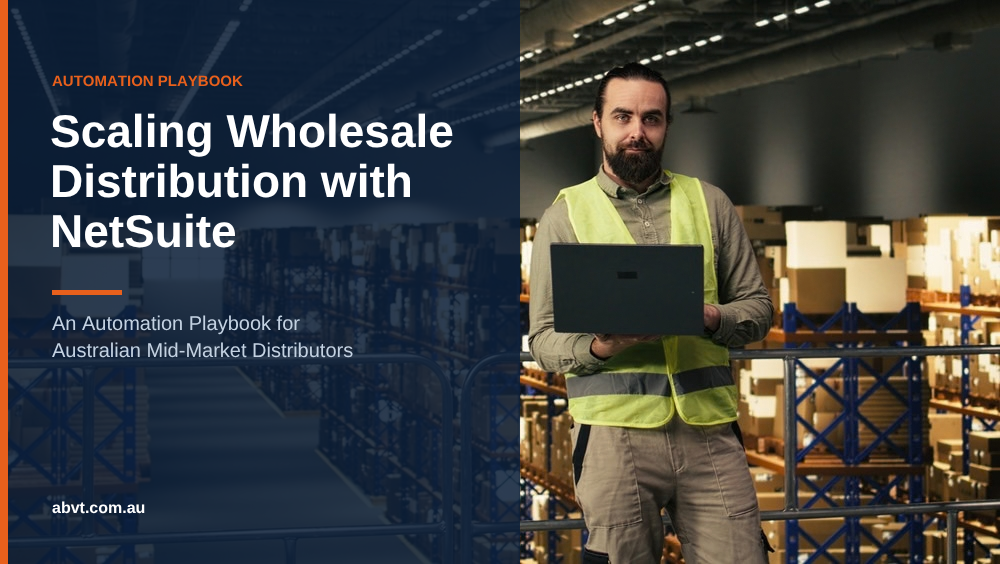
- Download the Scaling Wholesale Distribution automation playbook (PDF) to share internally or read offline.
- Build a boardroom-ready NetSuite business case in 30 minutes with AVT’s interactive wizard — includes distribution-specific ROI, TCO, and payback modelling.
- Book a no-obligation NetSuite evaluation call with AVT’s distribution specialists to scope your specific operational levers.
- Review the NetSuite for Wholesale Distribution & Retail solution overview to see the reference architecture in detail.